de.tech.ting

Sarah Palin's new Twitter page is a mess

Posted by andreaitis on November 10, 2009

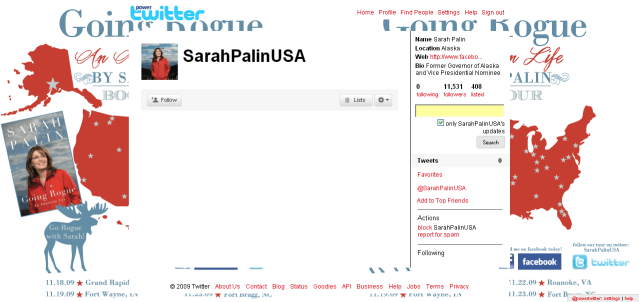
This is Sarah Palin’s brain on Twitter.   If it looks like a cluttered mess, don’t adjust that dial — you’re seeing it properly.  And that blank white space in the middle?  Oh, yeah, that’s where the thoughts are supposed to be.

sarah palin usa on twitter 11-10-2009 1-04-59 PM

You can follow the former Governor of Alaska and Vice Presidential candidate at  twitter.com/sarahpalinusa.

Who knows, maybe she’ll retweet @SenJohnMcCain

Posted in Politics, technology | Tagged: , , , | 3 Comments »

China's Entrepreneurial Journalist Hu Shuli

Posted by andreaitis on November 10, 2009

Hu Shuli

How much we take for granted as we all engage in incessant multimedia chatter about the death of newspapers and paywalls and search engines.

This should make us pause for a moment to reflect on bigger battles still being waged and those brave enough to truly fight for freedom of the press.

This is the face of Entrepreneurial Journalism.

The journalist Hu Shuli has often been called “the most dangerous woman in China.” And she may become even more so. As the pioneering editor of China’s most influential business magazine, she managed to publish groundbreaking stories on official ineptitude and financial malfeasance despite China’s tight control of the media. She may be on the verge of even greater freedom after cutting her ties with the owners of her magazine. On Monday, Hu announced that she was resigning from Caijing (Finance and Economics), the publication she built into one of China’s rare voices of journalistic autonomy. Instead, she and a core group of reporters and editors are going to form a new magazine.

via China’s ‘Most Dangerous Woman’ Hu Shuli Gets a New Forum – TIME

Caijing’s managing editor, Wang Shuo,  confirmed on his public  Twitter page that he and almost all the other top editors had  submitted their resignations.  One reporter said, “It doesn’t really matter which publication we work for. We just follow her. That’s it.”

We wish them all the best of luck.

Posted in Business | Tagged: , , , | Leave a Comment »

Your mobile phone can diagnose your cough

Posted by andreaitis on November 10, 2009

Gotta cough? There's an app for that.

The latest in hacking technology. Literally.

Soon all you’ll have to do is  cough into your phone for an instant diagnosis. Software being developed by STAR Analytical Services will measure your cough by comparing it to a pre-recorded database of coughs.

Software being developed by American and Australian scientists will hopefully allow patients simply to cough into their phone, and it will tell them whether they have cold, flu, pneumonia or other respiratory diseases.

The software would compare the patient’s cough to a pre-recorded database of coughs, containing the sounds of all respiratory diseases from people of both sexes and various ages, weights and other variables.

Currently the STAR team has a database of several dozen patients, but they estimate they will need a total of around 1,000 before the software will be reliable.

The software is currently run on a computer, but it is anticipated that it could be rewritten as a smartphone application.

via Cough into your mobile phone for instant diagnosis – Telegraph

The project is being funded by a $100,000 grant from the  Bill and Melinda Gates Foundation.

Hmm, mobile phone diagnosis.  Would this be considered a public or private option in the health care debate?

Posted in Health, technology | Tagged: , , , , , | 3 Comments »

Rupert Murdoch angry at 'content kleptomaniacs' and crazy like a fox

Posted by andreaitis on November 9, 2009

Rupert Murdoch - World Economic Forum Annual M...

Image by World Economic Forum via Flickr

Two pieces of news from the Murdoch empire:

1. New York Post circulation continues its downward death spiral.

Nearly every paper in America has lost circulation, but The Post more than most — down almost 30 percent in 2.5 years, to 508,000 in the most recent reporting period, against 544,000 for The Daily News. The slide accelerated after The Post’s price returned to 50 cents last year. And this year, The Daily News has surged far ahead in online readership.

[New York Post editor] Mr. Allan, who called it “a joyous occasion” when The Post took the lead, now takes a more subdued view of the competition, saying in an e-mail exchange that “whether we are a little in front or a little behind has no impact on our forward business plan.”

Sober Mood at New York Post as Circulation Spirals Lower – New York Times

2. Rupert Murdoch suggests he will remove News Corp. websites from Google and other search engines.  At least, that’s what the headlines are blaring.   Are they jumping the gun?  I think so.

If you listen to the first five minutes of Murdoch’s interview with Sky News political editor David Speers, you hear the following:

–  Speers delivers a classic and very public introductory suck-up,  referring to his interview subject (and big-time boss) as “the world’s most powerful media owner.”

–  Rupert Murdoch says users should not have had free content, that “we’ve been asleep.”  He sees the paywall as long overdue, but says we’ll be surprised by how minimal some of the fees will be.

–  He wants a different kind of audience – not drive-by consumers but loyal and engaged users with high-frequency habits.  Or, at least, users who will open their wallets.

“What’s the point of having someone come occasionally, who likes a headline they see in Google?… The fact is, there’s not enough advertising in the world to go around to make all the websites profitable. We’d rather have fewer people coming to our website, but paying.”

– At this point, Speers raises the Google index question.  When he asks Murdoch why he hasn’t removed News Corp. sites from Google’s search index, Murdoch replies “Well, I think we will.  But that’s when we start charging…”

BUT Murdoch doesn’t stop there.  He goes on, indicating that perhaps he didn’t fully understand Speers’ question.  They clearly were not communicating on the same, uh,  Google wavelength.

“…We do it already with the Wall Street Journal. We have a wall but it’s not right to the ceiling. You can get usually the first paragraph of any story, but then if you’re not a paying subscriber of wsj.com there’s immediately… a paragraph and a subscription form.”

Does that sound like he doesn’t want News Corp. content to appear in Google or Microsoft search results?  Nope.

Speers follows up, asking  if this is the model we should expect to see.  Murdoch’s clear as mud answer: “Maybe, maybe.” He mumbles something about the Fair Use Doctrine and taking it slowly.

So all those headlines shouting about Murdoch pulling his sites out of Google?  Not quite accurate.

When you take another  look at the comment from New York Post editor Col Allan, it all starts to make a bit of sense: “…whether we are a little in front or a little behind has no impact on our forward business plan.”

It seems Rupert Murdoch is saying size doesn’t matter.  It’s quality of audience, not quantity. The only quantity he wants is the dollars from subscribers, in both micro and macro payments.  Perhaps he’d rather build audiences that are meaningful, loyal and consistent because these are audiences that can be sold and targeted to an advertiser.

Will he pull all of his sites out of Google?  I doubt it.  When he refers to “content kleptomaniacs”  I’d venture he means not the initial link, but the pay-off link to the full story that is currently not providing a pay-out to the content creator or publisher.

Rupert Murdoch is bold and brash.  He is not stupid.   He is approaching the digital news  problem the same way he approached his move into television:   just because this is the way it’s being done doesn’t mean it’s the way it has to be done.

Remember when ABC, NBC and CBS were the only three networks?   Remember when CNN and MSNBC were the only dominant news players on cable?

I worked at Fox while Rupert Murdoch was transforming it.   I remember when he announced he was going to start a new cable news channel.  I walked through that studio as it was being built.  Murdoch is a challenger, even when the status has barely reached the quo.   I’m not counting him out just yet, and neither should you.

Watch the first five minutes of his interview with David Speers and you’ll see what I mean.

[youtubevid id=”M7GkJqRv3BI”]

Posted in Business, technology | Tagged: , , , , , , , , , , | 3 Comments »

World's first dedicated Twitter device now available. Because this is what the world needs.

Posted by andreaitis on November 3, 2009

Get a look at Twitter Peek while you can.

Get a look at Twitter Peek while you can.

The guys at Twitter apparently thought this was a good idea.  They partnered with Amol Sarva, founder of Peek Inc. , to build a new mobile device only for Twittering.  This is a variation of Peek’s other device, a “simple gadget allowing you to send and receive email while you’re on-the-go.”    Kind of like a mobile phone  minus the phone, calendar, address book, web browser, alarm clock….you know, all the other useful parts.

Anyway, the Twitter + Peek collaboration led to a version  of the Peek device exclusively  for sending tweets.

Clad in “Twitter blue,” the TwitterPeek allows all the same functionality of a desktop Twitter client – reading tweets, sending tweets, replying, retweeting and direct messaging – only it gives users that access on the go.

It’s really nothing new, though. Most new smartphones have access to Twitter. Sarva said the TwitterPeek is built for consumers looking for an affordable alternative to expensive smartphones with higher monthly fees. The TwitterPeek sells for $99 with a $7.95 monthly fee or $199 with a lifetime of service.

via The First Mobile Device Dedicated Exclusively To Twitter – Venture Capital Dispatch – WSJ

I have two questions:

1. Anyone remember the AOL Mobile Communicator?

I still have  one.  It doesn't even work all that well as a paperweight.

I still have one. It doesn't even work all that well as a paperweight.

2. Anyone still using the AOL Mobile Communicator?

[chirp. chirp.]

I rest my case.

Posted in technology | Tagged: , , , , , , , , | 8 Comments »

Google's social search circle jerk

Posted by andreaitis on October 27, 2009

This March 25, 2008 file photo shows the sign ...

Image by AFP/Getty Images via Daylife

Everything’s coming up search (again):  context and filtering through real-time search,  Twitter search,  social  search, Friendfeed,  people-powered search, etc etc.

So when Google launched its Social Search project in G-Labs yesterday, I was pretty excited to check it out.   I was all set for the test drive:   in one tab,  I clicked over and joined the experiment;  in another tab, I opened search  jedi master Danny Sullivan’s thorough review of Social Search.

One thing I love about the new service is how it makes use of the “social circle” term rather than “social graph,” a phrase more popular in 2007 and 2008 but which doesn’t really explain much to people. Social circle makes sense — these are people you are connected with. They’re in your “circle” of friends.

So far so good. I agree about use of the phrase Social Circle.   I never really understood Social Graph, and now I no longer have to  nod along in faux deep concentration while someone blathers on about the Social Graph.   So thank you for that, Google.

But how does Google know what your social circle is, in order to produce the social search results? Three methods, the company told me, when I talked with Google about the service:

* Your Google Reader account

* Your Google Chat / Gmail Contacts

* Your Google Profile

Okay, I read this part thinking ‘check, check, and check.’   I’ve got all that.  And then I did some testing.   Lame.  Hardly any social search results.  After the first few searches, I realized my downfall:  I have all that and more.  Multiple email addresses, some from way before Gmail existed.   My Gmail account never became my primary email address, and that is my social search downfall.  According to fellow T/S’er Kashmir Hill, it may also bring me domain shame and detract from my cool-ness, but I can live with that.   What I can’t live with is this Social Search limbo.

Do I need to change my email addresses at Twitter, Facebook, Friendfeed and  Flickr (to start)?

What if I merge my other email addresses into Gmail, will that solve my social search situation?

What about my email domain through Google Apps?

Is this yet again Google’s way of making me bow to its omnipotence on its march to world domination?

Am I just completely socially searchingly inept?

Head over to the Google lab and try social searching here.  My self esteem and I look forward to your feedback.

Posted in technology | Tagged: , , , , , , , | 2 Comments »

NYT editor started reading 'mostly digital news' 3 weeks ago. Contemplating cellular phone next.

Posted by andreaitis on October 20, 2009

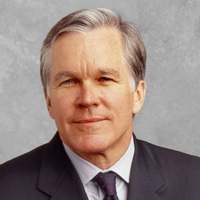
The headline caught my eye:  Bill Keller trying to read the Times “mostly in digital forms”.

Aged news.  That’s my first thought.  I mean, The Daily Show’s Jason Jones took New York Times Executive Editor Bill  Keller d-o-w-n when TDS invaded the NYT newsroom.

“Trying.”   That’s my second thought.  He’s trying to read the New York Times in digital form? I mean, how hard can it be?

Poorly written headline.  That’s my third thought.  I must be misreading that headline.  On to the story:

John Temple, former publisher of the defunct Rocky Mountain News, suggested in July that newspaper editors spend time exclusively reading news on the web, but Keller (and Times managing editor Jill Abramson) are the first I know who have tried it. I emailed Keller to see how the experiment is going, and he obliged with some observations on comprehensiveness, serendipity, and the “balky and drab” experience of reading the Times on a Kindle:

New York Times Executive Editor Bill Keller

It’s been about three weeks of consuming my NYT (and competition) mostly in digital forms: desktop (the website proper), TimesReader (on a notebook), iPhone and Kindle. In truth, I cheat some on weekends. I love print, and while this experience is making me appreciate more the versatility and creativity of our web staff, nothing has yet made me love print less.

via Bill Keller trying to read the Times “mostly in digital forms” » Nieman Journalism Lab

Brain overload:

1.  Yes, headline is correct.  He’s trying to read news in digital form…

2.  …for three weeks?  THREE weeks???

3.  Someone had to suggest he do this?!?!?

Love print all you want, Mr. Keller.  I love it, too.  Doesn’t mean I’m clinging to it on the cold hard streets outside the unemployment office which I can’t get into because there’s a long line ahead of other people who loved – and lost – print.   What’s that expression about loving something so much you have to set it free, and if it comes back it’s meant to be?

It’s not coming back, Mr. Keller.   Consider these three weeks your printervention.

Posted in Business | Tagged: , , , , , | 8 Comments »

Woman arrested for Facebook ‘poke’

Posted by andreaitis on October 10, 2009

Facebook poke

Image by liako via Flickr

The Tennessean reporting on what might be a first:  a woman arrested for virtually “poking” someone on Facebook,  violating an order of protection.

According to the affidavit filed in Sumner County General Sessions Court, Shannon Jackson is accused of using the “poke” option on Facebook to contact a Hendersonville woman, thus violating the terms of the order of protection, which stipulates “no telephoning, contacting or otherwise communicating with the petitioner.”

Violating an order of protection is a Class A misdemeanor. If convicted, violators can be punished with up to 11 months, 29 days in jail and a possible fine of up to $2,500.

via  Facebook ‘poke’ leads to woman’s arrest | tennessean.com | The Tennessean

The recipient of a Facebook “poke” receives a message saying “You’ve been poked by <insert Facebook user name>.”  Maybe not the traditional definition of contact or communication, but it’s contact all the same.  And it’s easy to see how a virtual poke can be just as threatening as a real-life poke.

Maybe the terms of an order of protection should be expanded to include no poking, sharing, emailing, friending, tweeting, IM’ing or DM’ing.  And maybe we all need to train ourselves in online self-defense mechanisms like privacy settings and blocking capabilities, just as we train for real-world self defense techniques.

Caveat Emptor Poker, people.

Posted in crime, technology | Tagged: , , , , , , | 5 Comments »

Washington Post crisis of credibility continues (but don't Twitter that)

Posted by andreaitis on October 5, 2009

“If you don’t get it, you don’t get it.”

That used to be the Washington Post’s ad campaign.

Ironic, huh?

Washington Post ombudsman Andrew Alexander wrote a piece yesterday in response to the Post’s anti-social media guidelines for reporters.  The title, Do Ethics Guidelines Threaten Freewheeling Social Media?, suggests these rules are about ethics.  They’re not.

It would have been fine if Executive Editor Marcus Brauchli said only this:

“What you do on social networks should be presumed to be publicly available to anyone, even if you have created a private account,” the guidelines warn. “If you don’t want something to be found online, don’t put it there.”

But he didn’t.  That good, basic common sense was just part of the guidelines that Brauchli summarized in a staff memo:

“Reporters and editors should not express views that can be construed as political, nor should they take sides in public debates.

There are prohibitions against “writing, tweeting or posting anything — including photographs or video — that could be perceived as reflecting political, racial, sexist, religious or other bias or favoritism that could be used to tarnish our journalistic credibility.” The guidelines “apply to all Post journalists, without limitation to the subject matter of their assignments.”

I presume Brauchli is okay with this memo making the rounds.  If not, he wouldn’t have written them in an email, right?  Here, though, is the final kicker in Alexander’s column:

To Brauchli, the policies speak to neutrality, which he told me is “essential to maintaining our credibility.”

Neutrality is not the only thing essential to maintaining credibility. Transparency is also essential.  Authenticity, an open dialogue and an open mind to how news happens in today’s world.  And these policies contain more neuter than neutrality.  Newsweek’s Dan Lyons is currently engaging in a conversation right here on True/Slant as journalism students dissect one of his columns.  If Dan worked at the Washington Post, he’d be violating their “prohibitions.”

You’d think the Washington Post would have learned something from the off-the-record exclusive access for cashola lobbyist scandal.

I guess it’s true.  If you don’t get it, you don’t get it.

Posted in technology | Tagged: , , , , , , , | 1 Comment »

New from True/Slant: Live Topic Streams, Alerts and Popular Posts

Posted by andreaitis on October 2, 2009

It’s the True/Slant trifecta today as we launch three new features: Live Topic Streams, Alerts and Popular Posts.  Lewis provided the overview; I’m following up with the inside view.

Live Topic Streams:  See all  T/S activity on a specific topic as it’s happening.  Our dynamic news streams include new posts, active conversations, active contributors, called-out comments, recommended posts, popular posts and more.  There are lots of ways to get to Live Topic Streams:

– Our Topics index page is now Live Stream central.  Click on Topics in the global nav (the black bar above) and select your topic of interest.

– Related Live Streams are just below every contributor post.   Scroll down Matthew Greenberg’s post (after reading and commenting, of course) to see the related streams.

More on TrueSlant 10-1-2009 9-19-48 PM

– Popular Live Streams (last 24 hours and all-time) are in the right column of Topic pages:  Health Care ReformEntertainmentBusiness

Alerts: T/S email alerts let you follow contributors, topics and conversations without missing a beat.

Get email alerts when your comments are Called Out by a Contributor:
1. Log in at trueslant.com
2. Click your name in red near the top of the page
3. Click on your Alerts tab
4. Select your preference next to When My Comments are Called Out

Get email alerts when there are new posts from Contributors and Topics you follow.
1. Log in at trueslant.com
2. Click “Follow” below a Contributor’s name or a Topic
3. Select timing for your email alerts – Immediate, Daily or Weekly

Already following Contributors and Topics? Here’s how to set up your email alerts:
1. Log in at trueslant.com
2. Click your name in red near the top of the page
3. Make sure you’re on your Dashboard tab
4. Scroll down to the list of Contributors and Topics you’re following and select timing for your email alerts – Immediate, Daily or Weekly

Get email alerts when there are new comments on a specific post
1. Log in at trueslant.com
2. Click on “Track comments via email alerts.”  You’ll see this at the bottom of a post or an existing comment thread
3. That’s it, once you click you’ll get email alerts when new comments are posted

Create default settings for Alerts:
1. Log in at trueslant.com
2. Click your name in red near the top of the page
3. Click on your Alerts tab
4. Select your preferencesMost Popular Posts 10-1-2009 9-31-26 PM

Popular Posts:

You can now see Most Popular Posts for specific contributors and the True/Slant network overall.  Look for this module in the right column on the T/S homepage and on most pages throughout the site.    Check the right column for T/S contributors Rick Ungar and Laurie Essig to see it in action.

That’s enough for today.   At this point, in the olden days of journalism we’d all go across the street for a drink.  In the new days of journalism we bask in the glow of  Pygmy hippo born in Rotterdam zoo (aka, jesus christ that’s cute) and Please tell Tufts about your roommate’s sex life.

Thanks for joining us here at True/Slant.  We appreciate it.

Posted in media, technology | Tagged: , , , , | 5 Comments »